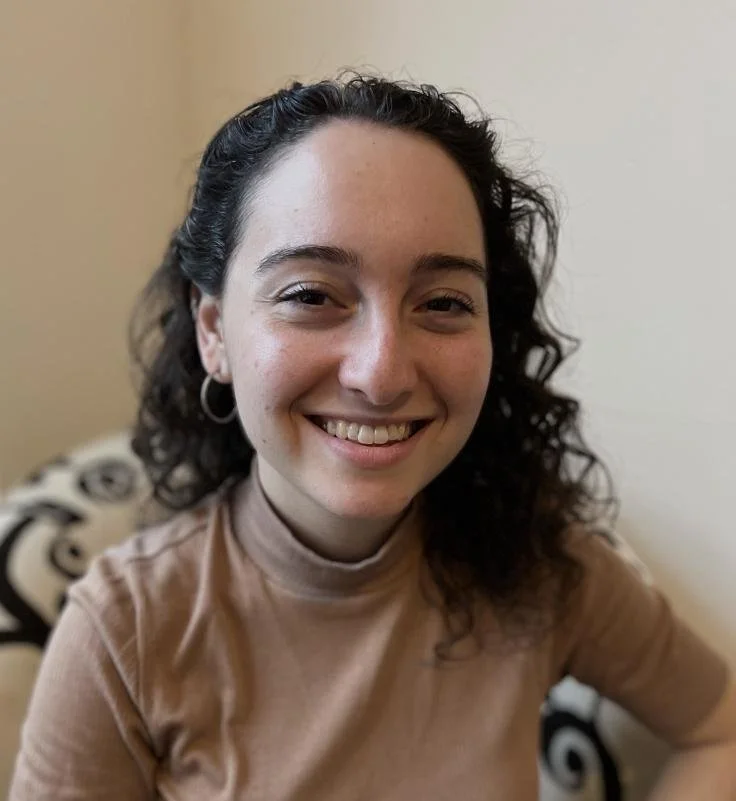
About Jocelyn Goldberg
I work with adults who are trying to make sense of experiences that were formative and are still, in some way, unfinished. Often that involves religion: a childhood shaped by strict expectations, a community that offered belonging alongside fear, a faith that changed, or a family that is still very much part of the picture.
My aim is not to tell you what to conclude about any of it. It is to give you a place where the whole thing can be described honestly — including the parts that contradict each other — and to look at how it still moves through your life now.
Much of my work is with people in their twenties and thirties, a period when inherited beliefs, family expectations and one's own emerging judgment tend to come into open conflict. I see clients in person on the Upper West Side and online throughout New York and New Jersey.
How I work
My approach is psychodynamic and relational. In practice that means we pay attention to patterns — what keeps happening, with whom, and what you find yourself bracing for — and to the feelings that are hard to say out loud. Sessions are conversations rather than protocols, and they are active: I ask questions, offer what I notice and respond.
When something practical would help, we use it. Skills for managing panic, preparation for a difficult conversation, structure during an unstable period — these sit alongside the deeper work rather than replacing it.
Training and credentials
- Licensed Mental Health Counselor (LMHC), New York
- Licensed Professional Counselor (LPC), New Jersey
- Postgraduate Certificate in Interpersonal Psychoanalytic Psychotherapy, William Alanson White Institute
- MA in Mental Health Counseling
My postgraduate training at the William Alanson White Institute is in the interpersonal psychoanalytic tradition, which gives particular weight to real relationships and lived context — family, community and culture — rather than treating a person's difficulties as sealed inside them. That emphasis matters for religious trauma, because these experiences happened within communities and are best understood there.
What it is like to work together
You do not need to arrive with an organized history or the right vocabulary. Most people begin somewhere in the middle, with whatever is loudest that week, and the shape of things becomes clearer over time.
You set the pace on what you discuss and when. I will not push you toward a conclusion about your faith, your family or your identity, and if I think another clinician or level of care would serve you better, I will say so directly.
Practical details
Free consultation. Initial sessions are 60 minutes and ongoing sessions are 50 minutes. In-person availability is at 110 West 96th Street, Suite 2B, upper west side office, currently tuesdays. See fees and insurance for the full details.